Danny and his siblings reach Yadaka’s cave
The Drover's WifeDanny and his siblings reach Yadaka’s cave at the end of an exhausting winter crossing, in a scene where survival depends on Danny’s memory of the route and his determination to keep the children together. The mountain has reduced the journey to immediate bodily danger: the boys are frostbitten, spent, and close to giving up, while Delphi is so cold that the children cannot tell whether she is dead or asleep. When Danny finally recognizes the three boulders that mark the way, the cave becomes more than shelter. It is the place he promised his mother he would find, and the first credible opening toward food, safety, and reunion with people in spring.
The winter crossing
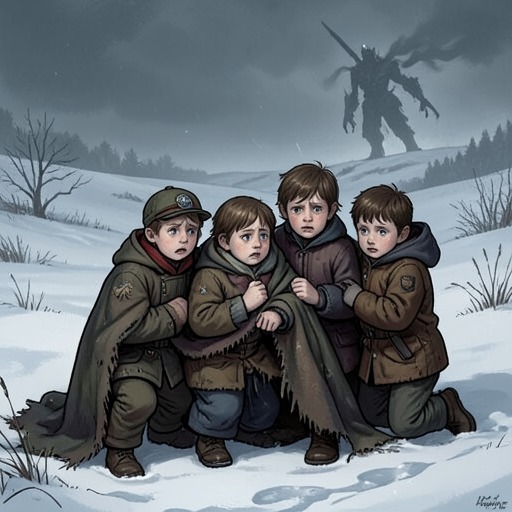
High in the snow-covered mountains, a branch cracks under the weight of the snow. The sound startles the children, but their more urgent danger is exhaustion and cold. Henry James falls into the deep snow, worn out; Danny carries Delphi on his back, her lashes edged with tiny icicles. The uncertainty about whether she is sleeping or dead gives the trek its starkest measure: Danny is not simply guiding his siblings toward a destination, but carrying a child whose life may already be slipping beyond his control.
The landscape dwarfs them. Snow reaches their knees, and Joe Junior helps his little brother to his feet as they trudge on. The boys are frighteningly cold and close to surrender, yet they keep moving together. Their progress is measured less by any visible improvement in the conditions than by small acts of mutual assistance: a brother helping another rise, Danny bearing Delphi’s weight, and the children continuing when each has reason to stop.
Finding the way
Danny searches desperately for the landmark he remembers: three large boulders arranged like emu eggs. He scans from boulder to boulder, but the familiar formation is not immediately apparent. The burden of saving all the children presses on him, and he is on the verge of tears. The search makes his responsibility visible as more than a promise or a claim of courage; if he cannot recognize the place, there is no clear alternative in the scene to the danger of remaining in the snow.
A woman with fire-red hair appears beside a boulder in the distance. Danny blinks, and she vanishes. The narration leaves the vision unexplained, but its placement coincides with the moment the landmarks come into view: Danny looks again and sees the three great boulders standing before him. He has found the route and done what he said he would do for his mother. The arrival is thus both a practical recognition of place and the fulfillment of an obligation that has sustained him through the journey.
The cave and what it promises
Danny tells his brothers that the cave lies just beyond the three boulders. Joe Junior and Henry James tilt their heads, trying to see the emu-egg shape; Joe Junior privately compares it to wombat droppings, and Henry James agrees. Their joke briefly restores a child’s scale of attention to a scene dominated by cold and fear. Danny smiles at them. The humor does not erase the danger, but it marks a change: the brothers can look at the landmark together rather than face the landscape only as a threat.
Danny names what the destination can offer: “Food, shelter and, in the spring, people”. The order matters. Food and shelter answer the immediate crisis; people remain a future prospect tied to the return of spring. In an earlier conversation, Yadaka explained the seasonal journey from the mountains northward: his people came down when the first mist rose in the valleys so that their feet would not get cold. Danny recognized that the first mist had come and asked why Yadaka was still there. That exchange places the children’s arrival within a larger pattern of seasonal movement, while Yadaka’s inability to leave underscores the circumstances that have interrupted it.
A fragile passage to safety
Feeling confident, the brothers take one another’s hands and follow the path of the fair-skinned Aboriginal woman with fiery red hair. Together they disappear behind the boulders. The passage into the cave is the scene’s decisive turn from exposure toward refuge, but the narrative does not present it as a complete resolution: the children have reached shelter after severe cold, and springtime contact with other people is still ahead.
The journey also recalls an earlier danger beside a swollen river, where Delphi’s rag doll floated away in floodwater and Molly pulled her back from the edge as the children struggled to understand how quickly the current had risen. In both episodes, a child’s vulnerability makes the force of the environment immediate; in the mountains, however, Molly is absent, and Danny must act as the one who carries, searches, and leads. His achievement is therefore not simply that he reaches a cave. It is that he brings his siblings to its threshold together, turning the responsibility he accepted for his mother into a concrete act of protection.
The children’s ordeal unfolds against the larger history of Ngarigo displacement. Settlers fenced land, drove Aboriginal people from their homelands, and disrupted the seasonal life through which people had moved across Country. Against that history, the cave represents both immediate refuge and a fragile continuity with the people and routes that colonial force has sought to scatter. Its promise is modest and conditional—shelter now, people when spring returns—but it gives the children a future beyond the snow.